

The right art program for an adult with special needs in Dubai is one built specifically for adults, with real skill-building, experienced staff, and a space you are welcome to visit before you commit. It is not a downsized version of a children’s class, and it should never feel like the goal is simply to keep your adult child occupied for a few hours.
If you are searching for special needs art classes in Dubai for an adult family member, you have probably already noticed the problem. Most of what comes up online is written for children. Your son or daughter is not a child anymore, and the questions you are asking now (about dignity, structure, and what happens next) are different from the ones a parent of a five-year-old is asking. This checklist is written for you.
Why Adult Programs Need to Be Different from Children’s Art Classes
Children’s art classes are usually built around fun, term-based learning, and creative play, often just an hour a week. That is the right model for a child. It is the wrong model for an adult of determination who may be looking for a place to spend their days, build real skills, and be part of a working community.
An adult program should treat the person in front of it as an adult first. That means adult-appropriate materials and projects, adult conversation and expectations, and a daily rhythm that looks more like a working studio than a classroom. If a program cannot describe how it is different for adults versus children, that is worth asking about directly.
The Parent’s Checklist: What to Look for in Special Needs Art Classes in Dubai
Use this list as a starting point when you compare programs.
Adults only, not a mixed-age setup. Ask whether the program works exclusively with adults, or whether adults are placed into a children’s class because there is nowhere else for them to go.
Real artistic and life skill development. A strong program should be able to explain, specifically, what skills are being built through the art itself: focus, fine motor control, following multi-step projects, working alongside others, and finishing something they are proud of.
No clinical or therapy claims. Be cautious of any program that promises to treat, cure, or clinically improve a condition through art. An honest art studio will describe itself as exactly that, a studio, not a medical or therapy service, and will be clear about the difference.
Staff experience with adults of determination. Ask about staff-to-student ratios and how long the team has worked specifically with adults, not just children, with disabilities.
A space you can actually visit. A program confident in what it offers will welcome you to see a real day in progress, meet the artists and the team, and ask questions on-site before you decide anything.
Dignified, respectful language throughout. Notice how the program talks about the people it serves. Are they described as artists and students, or only ever as patients or cases needing help? Language is a good early signal of how someone is actually treated day to day.
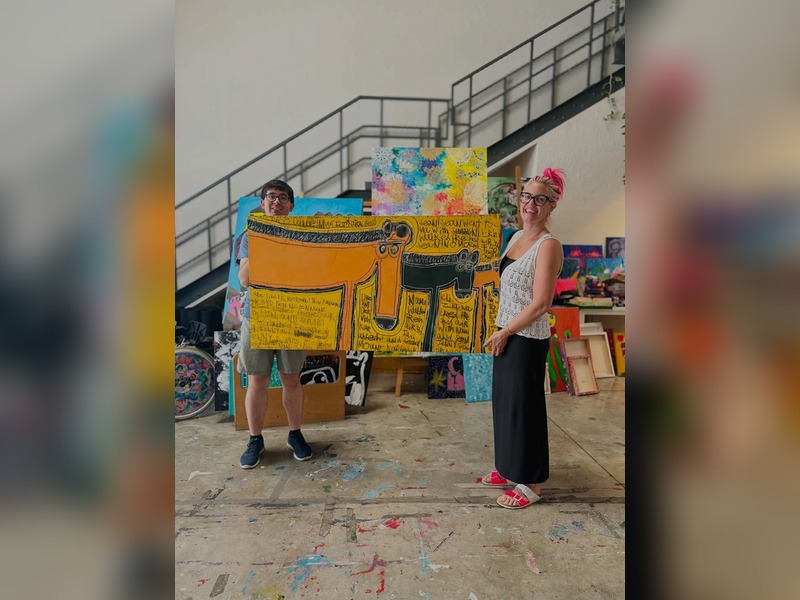
Visible proof, not just promises. Look for named artists, real artwork, testimonials, and a history you can verify, rather than generic stock photography and vague claims.
A community around the work. Isolation is one of the hardest parts of adult life for many people of determination. A program connected to a wider community, whether through a cafe, exhibitions, or corporate visits, gives your adult child more than a class. It gives them a place.
What Should Families Look for in a Day Program in Dubai?
Choosing a day program is a bigger decision than it looks, because it shapes years of your adult child’s routine, relationships, and growth. A few things are worth checking before you commit.
Adult-focused, not child-focused. Ask whether the program is designed specifically for adults, with adult-appropriate activities, language, and expectations, or whether it is a down-scaled version of a children’s program.
Real skill-building, not just supervision. Look for a clear structure around life skills and, where relevant, vocational or artistic skill development, not just a supervised space to pass the day.
Staff experience and ratios. Ask about staff-to-student ratios, staff training, and how long team members have worked with adults of determination specifically.
A visible, visitable space. A program that welcomes you to visit before enrolling, meet the team, and see a real day in progress is a strong sign of transparency.
Community and social connection. Isolation is one of the biggest risks after school ends. A program that builds friendships and a sense of belonging matters as much as the skills taught.
A path forward. Ask what progress looks like a year in, two years in, five years in. Independence is a direction, not a single finish line.
What Questions Should You Ask Before Enrolling?
A short visit and a good conversation will tell you more than any website. A few questions worth asking directly:
- What does a typical day actually look like, from arrival to pickup?
- How long has your team worked with adults specifically, and what is your staff-to-student ratio?
- Can I see examples of work by current student artists?
- What happens if my adult child is having a difficult day? How is that handled?
- Is this a studio and community setting, or a clinical or therapeutic one? (You want a clear, direct answer either way.)
- What does progress look like after six months, a year, and beyond?
If a program cannot answer these clearly and specifically, that is useful information too.
What Does a Good Day Look Like in an Inclusive Art Studio?
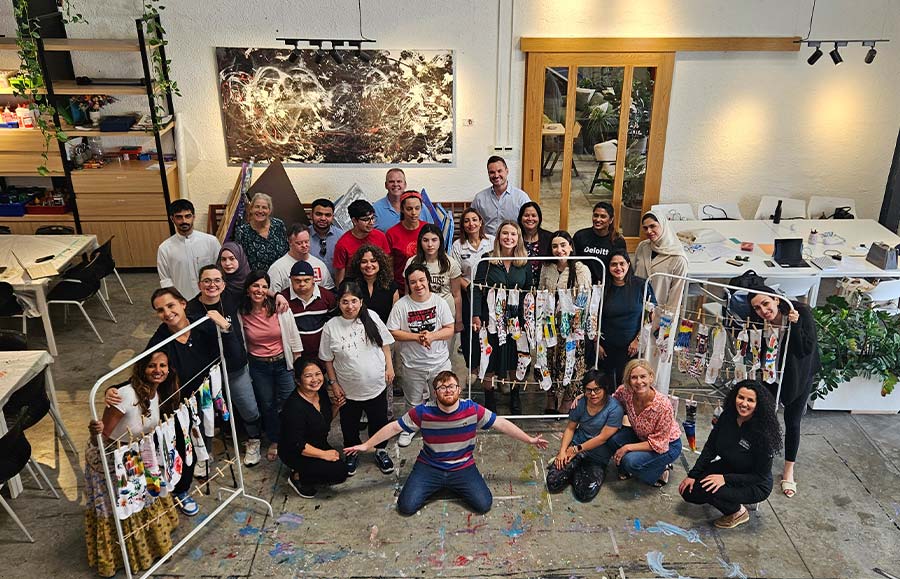
In a well-run adult art studio, the day is built around real work, not busywork. Student artists arrive to a structured routine, work on their own pieces or shared projects across painting, drawing, or mixed media, and practise the life skills that come naturally with studio life: showing up on time, following a project through to the end, communicating with teachers and peers, and taking pride in finished work.
The best programs also build in genuine points of contact with the wider community, whether that is a cafe next door, visiting exhibitions, or corporate teams coming in to work alongside the artists. That contact matters. It is where inclusion stops being a word on a website and becomes something that actually happens, in person, regularly.
How Mawaheb Approaches This in Al Quoz
Mawaheb has run its studio program for adults of determination since 2010, when founder Wemmy de Maaker started the studio with a small group of student artists. In 2020, the studio moved to a larger, purpose-built space in Al Quoz, next to its own community cafe, where student artists’ work is shown and sold to the public every day.
The studio works exclusively with adults, never children, and the daily program is built around real artistic practice rather than a fixed lesson plan. Student artists work alongside a dedicated Life Skills Instructor, Art Teacher, and Assistant Teacher. Mawaheb is an art studio and social enterprise, not a medical or therapy provider, and its focus stays on artistic skill, life skills, and community rather than clinical treatment.
Families are welcome to visit the Al Quoz studio and cafe before making any decision, meet the team, and see the space and the work for themselves.
Ready to See It for Yourself
The clearest way to know if a program is right for your adult child is to visit it in person. If you would like to see Mawaheb’s studio and cafe in Al Quoz, meet the team, and get a feel for a real day in the program, reach out to arrange a visit.
Frequently Asked Questions
What should I look for first when comparing special needs art classes in Dubai for an adult?
Start with whether the program is built specifically for adults. Many “special needs” programs in Dubai are designed for children, so ask directly whether adult-appropriate content, staff experience, and daily structure are in place before looking at anything else.
Is Mawaheb a therapy service?
No. Mawaheb is an inclusive art studio and community café, not a licensed medical or therapy provider. Its work centres on artistic and life skill development, not clinical treatment.
Does my adult child need previous art experience to join?
No prior art experience is required. Programs built around real skill development, like Mawaheb’s studio, are designed to work with each student artist from wherever they are starting.
Can I visit before enrolling?
Yes, and it is worth insisting on this with any program you are considering. Visiting Mawaheb’s Al Quoz studio and café is welcomed and is the clearest way to see the daily program in person before making a decision.
How is an adult program different from special needs art classes for children?
Adult programs are built around adult-appropriate materials, adult conversation and expectations, and a working studio rhythm rather than a term-based class. The goal shifts from creative play towards real skill-building, independence, and community.