

For most families, school is the anchor. There is a routine, a building to go to, a teacher who knows your child, and a plan for what comes next. Then a child with a disability turns 18, finishes their final year, and that anchor disappears. This is one of the most under-discussed transitions for families of adults with special needs in Dubai, and it catches many parents off guard.
The short answer to “what happens after school” is this: your adult child needs a new kind of structure, one built for adults, not children. In Dubai, that structure most often takes the shape of a day program, a setting where adults of determination continue to learn, build life skills, socialise, and work towards independence, long after their school years are behind them.
This guide walks through what day programs for adults with special needs in Dubai actually look like, what to look for when choosing one, and how the transition to adulthood works in practice.
What Happens When a Child With a Disability Turns 18 in the UAE?
In most school systems, support for children with disabilities ends at a fixed age, often between 18 and 21 depending on the school. Once that ends, there is no automatic next step. Families are left to find their own path.
This gap is sometimes called the “services cliff,” and it is a real and documented challenge in disability communities worldwide, not just in the UAE. Without a plan, adults of determination can lose the routine, social connection, and skill-building that school once provided. That is exactly the gap that adult day programs are designed to fill.
What Is a Day Program for Adults With Special Needs?
An adult day program, sometimes called adult day services, is a structured setting that adults with disabilities attend regularly, similar in rhythm to a workday or school day, but built entirely around adult goals. Instead of a school curriculum, the focus shifts to life skills, vocational training, creative or occupational activity, and community inclusion.
A good day program is not childcare for adults. It is a place where adults of determination are treated as adults first, with real skills to build and real work to show for it. In Dubai, these programs range from vocational and life skills centres to inclusive art studios like Mawaheb, where the daily structure is built around a working art studio rather than a classroom.
What Should Families Look for in a Day Program in Dubai?
Choosing a day program is a bigger decision than it looks, because it shapes years of your adult child’s routine, relationships, and growth. A few things are worth checking before you commit.
Adult-focused, not child-focused. Ask whether the program is designed specifically for adults, with adult-appropriate activities, language, and expectations, or whether it is a downscaled version of a children’s program.
Real skill-building, not just supervision. Look for a clear structure around life skills and, where relevant, vocational or artistic skill development, not just a supervised space to pass the day.
Staff experience and ratios. Ask about staff-to-student ratios, staff training, and how long team members have worked with adults of determination specifically.
A visible, visitable space. A program that welcomes you to visit before enrolling, meet the team, and see a real day in progress is a strong sign of transparency.
Community and social connection. Isolation is one of the biggest risks after school ends. A program that builds friendships and a sense of belonging matters as much as the skills taught.
A path forward. Ask what progress looks like a year in, two years in, five years in. Independence is a direction, not a single finish line.
How Do Day Programs Support the Transition to Adulthood?
The transition to adulthood is not a single event. It is a gradual shift in how much support a person needs and how much independence they are building towards. Day programs support this by giving adults of determination a consistent place to practise adult skills in a low-pressure, supportive environment.
That might mean learning to follow multi-step instructions, managing time and routine, working alongside others towards a shared goal, or simply building the confidence to try something new. Over months and years, these small, repeated wins add up to real independence, whether that means more autonomy at home, a stronger sense of identity, or, for some, a path towards paid or supported work.
What Does Life Skills and Vocational Training Actually Look Like?
Life skills and vocational training for adults of determination in Dubai typically blend practical, everyday skills with a specific craft or trade the person can build real competence in.
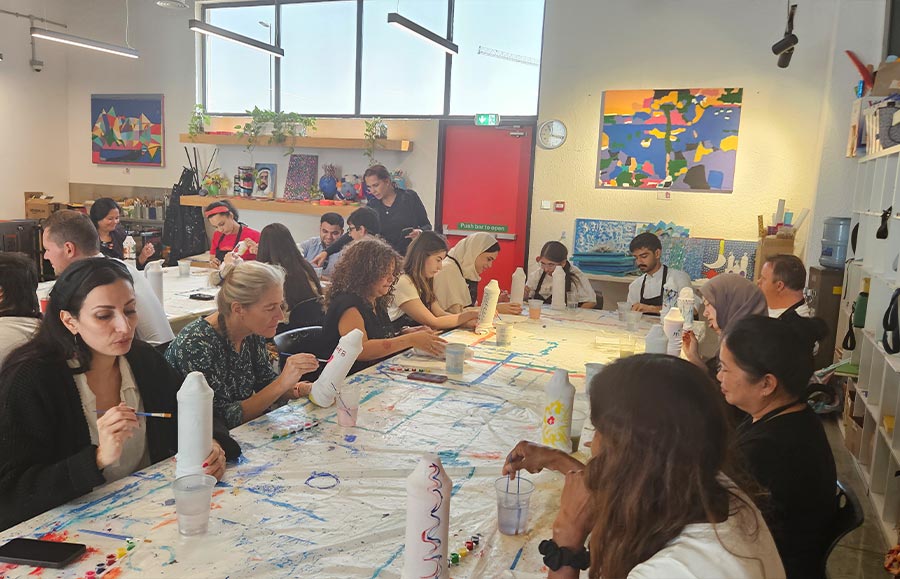
At Mawaheb, for example, the studio model means life skills are built inside the context of real artistic and creative work. Student artists develop focus, patience, and fine motor skills through painting, drawing, and mixed media work, while also practising communication, teamwork, and independence as part of the daily studio routine. The result is not just a finished artwork. It is a person who has practised showing up, contributing, and finishing something they are proud of.
This is different from a purely clinical or therapeutic setting. Mawaheb is an art studio and community café, not a medical or therapy provider, and its approach centres on artistic and vocational growth rather than treatment.
How Does Inclusion Factor Into an Adult Day Program?
Inclusion works best when it goes both directions. A strong adult day program does not only serve people of determination behind closed doors. It also creates real points of contact with the wider community.
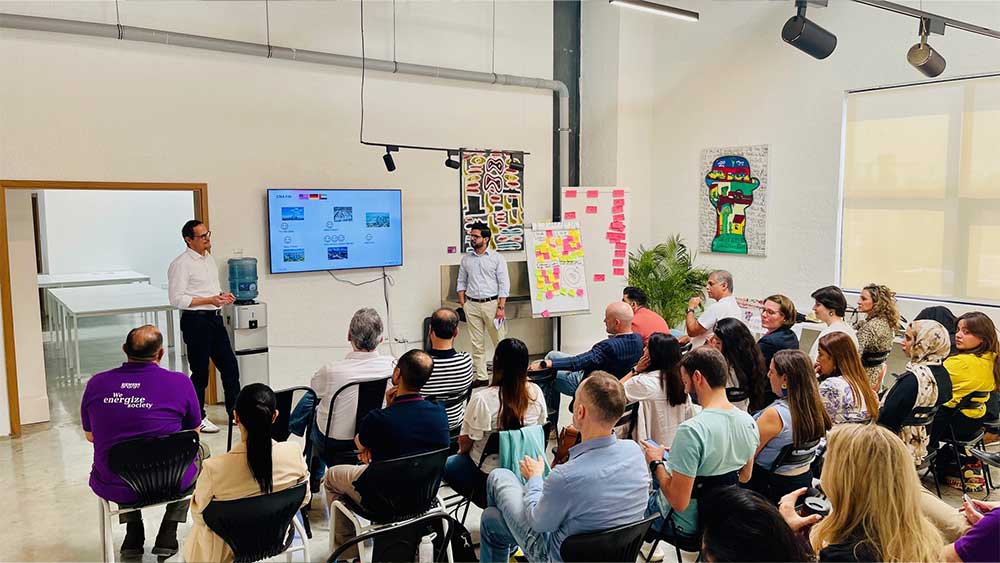
Mawaheb’s model reflects this directly. The studio sits next to a working community café in Al Quoz, where the public can sit, order coffee, and see student artists’ work on the walls, often meeting the artists themselves. Corporate teams visit for CSR days, working alongside student artists on shared projects. Exhibitions with partners such as DIFC and Emirates NBD bring the art, and by extension the artists, into wider public view. Inclusion, in this sense, is not a slogan. It is café tables, gallery walls, and shared workdays.
What Does Independence Really Mean Here?
Independence does not always mean living alone or holding a full-time job, though for some adults of determination it can mean exactly that over time. More often, independence is built in smaller, daily layers: making a choice, completing a task without step-by-step guidance, managing a routine, or contributing something of value to a shared project.
Mawaheb’s mission, in its own words, is to encourage each person with special needs to reach their highest potential through art, enabling them towards independence. That framing matters. Independence is treated as a direction to keep moving in, shaped around each person’s own pace and potential, not a single outcome everyone is expected to reach the same way.
How Mawaheb Approaches This in Al Quoz
Mawaheb has been running its studio program since 2010, when founder Wemmy de Maaker, a Dutch expat and art enthusiast, started the studio with a small group of student artists in Bastakiya. In 2020, the studio moved to a larger, purpose-built facility in Al Quoz, alongside its art café, giving the program more room to grow.
Today, student artists work alongside a small team that includes a dedicated Life Skills Instructor, Art Teacher, and Assistant Teacher, with daily studio life built around real artistic practice rather than a fixed lesson plan. Families are welcome to visit the Al Quoz studio and café in person before making any decision, meet the team, and see the space and the work firsthand.
Thinking About What Comes Next?
If your family is facing the question of what happens after school, you are not alone, and you do not have to figure it out from scratch. Visiting a program in person is often the clearest way to know if it is the right fit. If you would like to see Mawaheb’s Al Quoz studio and café for yourself, or talk through what the program looks like day to day, reach out to arrange a visit.
Frequently Asked Questions
Is Mawaheb a school for children with special needs?
No. Mawaheb works exclusively with adults of determination. It is not a children’s school and does not offer paediatric services
Is Mawaheb a therapy or medical service?
No. Mawaheb is an inclusive art studio and community café, a social enterprise, not a licensed medical or therapy provider. Its focus is artistic skill, life skills, and community, not clinical treatment.
Does my adult child need prior art experience to join?
No prior art experience is needed. The studio is built to develop artistic and life skills from wherever each student artist is starting.
How do I find out about enrolment and program details?
The best next step is to reach out directly and, where possible, visit the Al Quoz studio in person to see the program and meet the team before making a decision.
What happens after a student artist joins Mawaheb?
Each student artist works within the daily studio program at their own pace, building artistic skill, life skills, and independence over time, alongside the wider studio community.